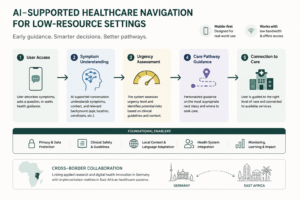
The project explores the development of a mobile-first, AI-supported healthcare navigation system for low-resource settings. It focuses on improving earlier navigation within fragmented care pathways by supporting users in understanding symptoms, assessing urgency, and identifying appropriate next steps for care. The solution combines contextual insight from East Africa with research, governance, and implementation perspectives anchored in Germany. The project also creates an opportunity for cross-border collaboration around AI-supported healthcare navigation, linking applied research perspectives in Germany with real life implementation in East African healthcare environments.
Herausforderung/Potenzial der Gesundheitsbranche
Healthcare systems in many low-resource settings are forced to operate reactively because patients often enter care pathways too late, too uncertain, or through inappropriate channels. Between the onset of symptoms and clinical care, people frequently rely on fragmented sources of guidance such as informal advice networks, pharmacies, social media, or general internet searches that are not calibrated to their clinical or local context. This project explores whether AI-supported healthcare navigation tools can strengthen earlier decision-making, improve care pathway orientation, and ultimately contribute to better health outcomes in resource-constrained environments.
Die Lösungsidee von My Musawo
The project is designed for healthcare users navigating low-resource healthcare environments, particularly in settings where access to timely medical guidance and structured care pathways is limited.
The initial deployment context is East Africa, where fragmented healthcare navigation and delayed escalation remain significant contributors to preventable health complications.
The concept explores a mobile-first AI-supported guidance system that helps users better understand symptoms, assess urgency, and identify appropriate next steps for care. Rather than replacing clinicians, the system is intended to function as an earlier orientation layer before formal clinical contact, supporting more informed healthcare decisions and more efficient navigation of existing care pathways.
From a digitalisation perspective, the project explores how context-aware AI systems can support healthcare access in resource-constrained settings while remaining adaptable to local clinical realities, infrastructure limitations, and patterns of health-seeking behaviour. The collaboration also creates opportunities for applied cross-border research linking digital health innovation in Germany with real-life implementation in East African healthcare systems.
Gesuchte Partner
Science & Research / Digital Medicine Partner:
– Support and coaching in clinical AI governance, digital health research design, validation strategy, and scientific evaluation of the proposed system.
– Contribution of expertise in digital medicine, interdisciplinary healthcare innovation, and clinically responsible implementation pathways within regulated environments.
– Collaboration around healthcare navigation, AI-supported decision support systems, and translational digital health research.
Clinical Practice Partner (Doctor’s Office / Hospital):
– Contribution of practical clinical insight into patient navigation challenges, first-contact care realities, symptom escalation patterns, and real-world healthcare workflows.
– Support in ensuring that proposed guidance pathways remain aligned with practical healthcare delivery environments and patient behaviour patterns.
Small to medium-sized enterprise / Implementation Partner:
– Support in project coordination, implementation strategy, operational planning, and translation between research, technology development, and real-world deployment considerations.
– Contribution of experience in healthcare innovation processes, regulated environments, and interdisciplinary collaboration to strengthen practical execution and long-term scalability.
Health Insurance / Systems Partner:
– Perspective on healthcare accessibility, prevention oriented care pathways, and sustainable healthcare navigation models within low-resource environments.
– Support in exploring how earlier guidance, improved navigation, and potential micro-health coverage could contribute to more accessible and sustainable healthcare pathways.
– Coaching and strategic insight around healthcare financing models, population-level access challenges, and system-level integration opportunities.